
Delivering timely, high-quality advice outcomes
Lisa Broad, Clinical Nurse GPLO, Sunshine Coast Health
General practitioners (GPs) may now submit a request for advice to a specialist instead of sending a referral or contacting the on-call Medical Officer (MO).
The Smart Referrals Request for Advice (RFA) electronic communication pathway supports patient-centric, effective healthcare in the primary care setting. It enables easy access to specialist advice, improving patient care and advancing partnerships between GPs and specialists—with multiple other benefits across the healthcare spectrum.
Challenges with established flows for specialist advice
Telephone calls to on-call Medical Officers (MOs)
This informal communication flow creates several inefficiencies:
- Telephone inquiries interrupt clinical activity for GPs and Queensland Health MOs.
- Advice is often provided indirectly without a comprehensive view of the patient’s health record, creating clinical risk and creating record retention challenges.
- The lack of formal tracking means this activity is not captured in workforce planning, often resulting in a default recommendation to formally refer the patient.
Referral submission
- Many referrals could be avoided through better advice pathways; currently, they contribute to longer waitlists and delayed patient access.,
- High referral volumes create a heavy triage workload, requiring extensive data entry and multiple administrative “touchpoints.”
- additional costs due to multiple stakeholders in referral pathway, and communication requirements to patient and GP.
Delivering practical solutions to key healthcare challenges
The RFA pathway has advantages for all stakeholders:
- Patients receive timely, in-scope healthcare close to home.
- GPs get access to specialist-supported assistance for care provision, potential upskilling, and greater efficiency to ease time constraints (RFAs can be submitted and responses reviewed when convenient).
- Queensland Health specialties receive reduced calls to the on-call MO, improved waitlist avoidance, visibility of this activity, record of request and advice is retained in the patients’ health record.
- Hospital and Health Services get eConsult funding for each outcome of advice provided, data for health service planning, and strategies such as development of or improvement in published resources and education opportunities.
Drivers for adoption of RFAs by specialties include:
- executive support (as with all successful projects)
- identification of health service RFA champions with Smart Referrals and outpatients knowledge
- audience specific training resources
- allocation of time for monitoring and managing queues and escalation if delays.
Drivers for GP uptake of RFAs include:
- communication via the GP Liaison Office
- inclusion in HealthPathways
- presentation of onboarded specialties and ease of submission at education forums
- timely responses to submitted RFAs.
Activities for onboarding
- Proactively approach directors of specialties.
- Liaise with and include nurse unit managers (NUMs), administration coordinators and specialty clinical nurses.
- Clearly and concisely outline the benefits to the nominated audience—be it the GP, manager or specialist.
- Address perceived barriers with confidence.
- Be aware of potential volume and time requirements and the likelihood of RFA replacing referral activity.
- Provide timely training and system access.
- Circle back to specialty directors who initially declined.
- Offer ongoing support as required.
Constraints
- Perceived strain on specialists’ time.
- Non-specialist triage of referrals – a couple of specialties have registrar triage; therefore, the SMOs do not access Smart Referrals Workflow Solutions (SRWS).
- Specialties that do not have a medical lead (e.g. allied health, nurse navigator services, diabetes education service, Aboriginal and Torres Strait Islander Health Services) are not in scope for RFA.
Partial onboarding of specialties within an hospital and health service presents issues of:
- Inability to reassign the RFA to a more appropriate specialty in which case, Referral Recommended is the outcome. This results in inconsistency from a GP perspective.
- If patients are under the care of a Specialist MO who does not access SRWS, RFAs must be managed outside of the SRWS system, delaying delivery of advice to the GP.
Factors that contribute to sustainability of the RFA pathway include:
- ongoing support of specialists and GPs to maintain confidence in the system
- ongoing training of specialists, administrative staff and clinical nurses
- monitoring of KPI compliance (response within 5 business days)
- sourcing of IT opportunities to streamline and enhance the pathway.
Future opportunities for Sunshine Coast Health include:
- extension to more medical specialties – currently 22 specialties are onboarded, representing approximately 62% of potential specialties
- ensuring all SMOs in specialties use SRWS for timely management of RFAs including ‘in-care’ patients
- auditing of RFAs to identify themes
- surveying GPs and SMOs to capture user experience and feedback
- creating reports for specialties to view volume, outcomes and funding.
Information specific to Sunshine Coast Health
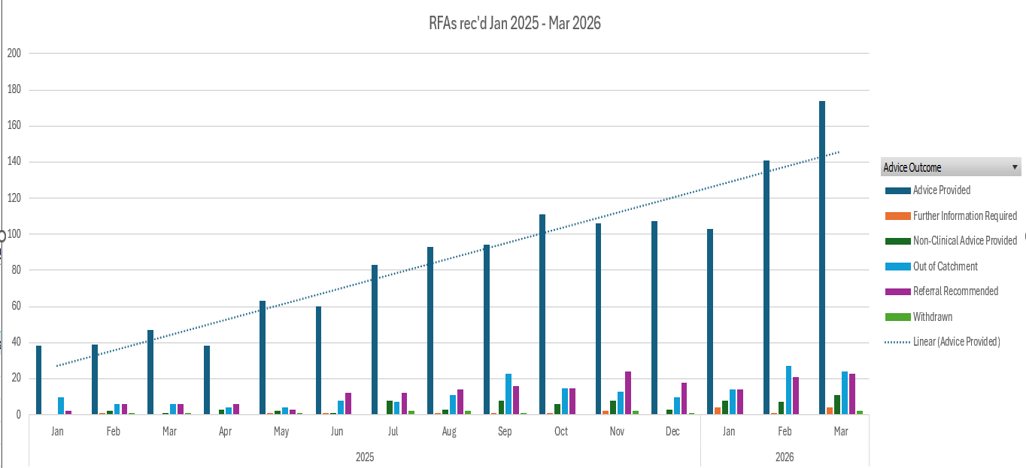
RFAs received from January 2025 to March 2026
(click to enlarge)
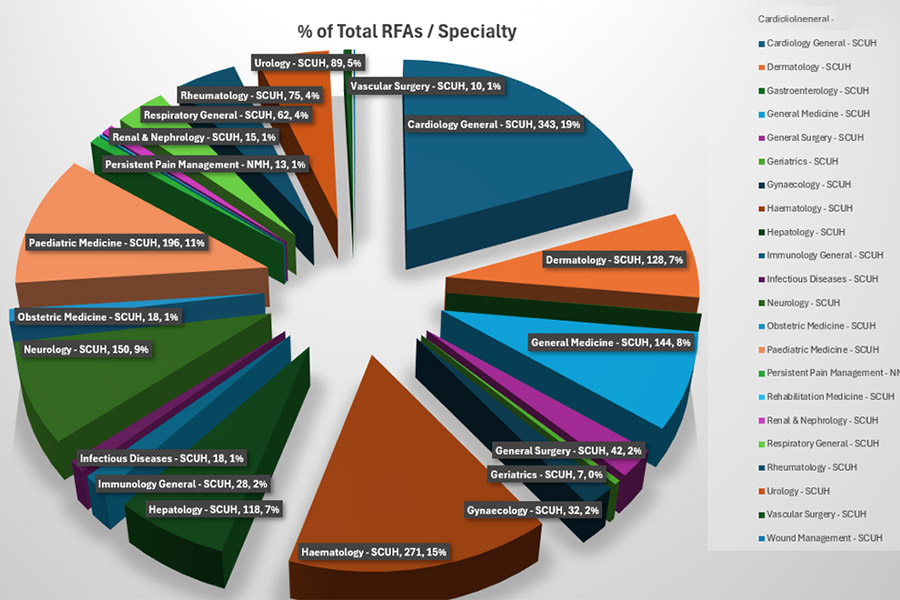
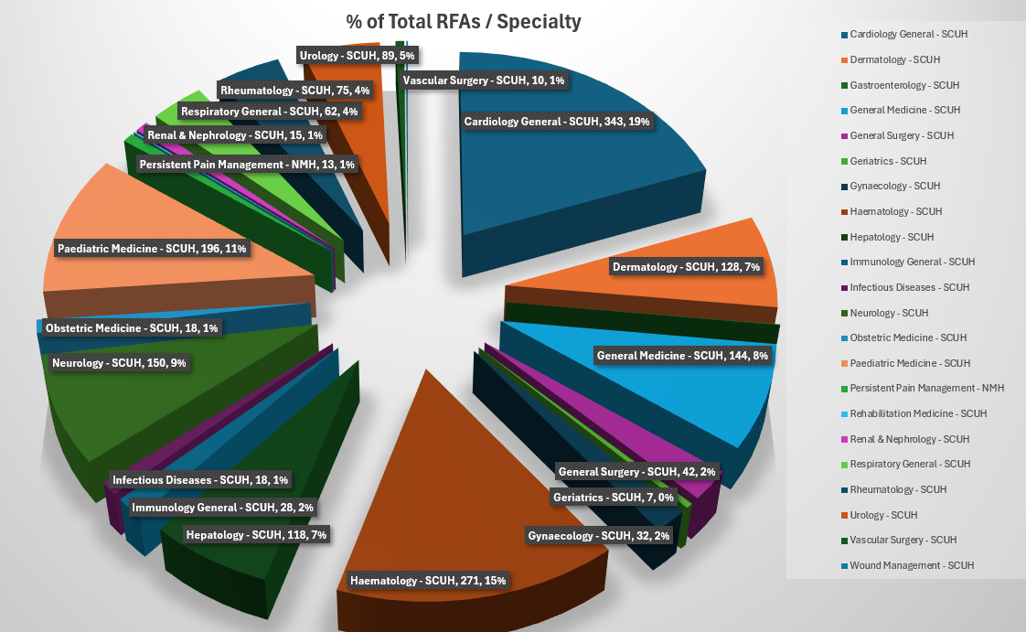
Percentage of Total RFAs per Specialty
(click to enlarge)
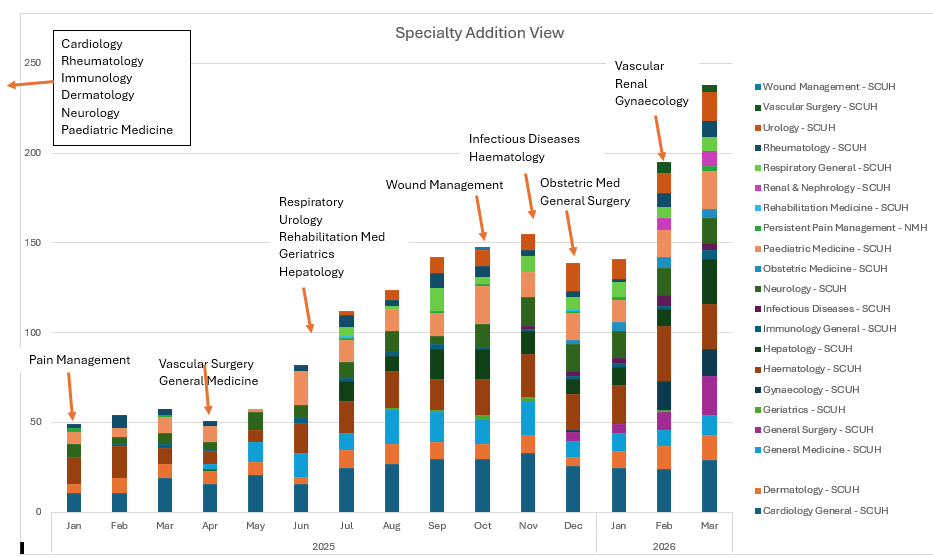
Timeline of RFA Volume received: specialties onboarded
(click to enlarge)